Ealing Development Finance 2026: The Crossrail Outperformer — North Acton, Southall Gasworks & The Six-Station Borough
Ealing is up 0.8% year on year in February 2026 (HM Land Registry), against a Greater London headline of -3.3%. That puts the borough 410 basis points above the regional benchmark and into the rare 2026 outperformer bracket alongside its sister Crossrail boroughs Walthamstow at +5.9% and Redbridge at +5.3%. Ealing is not on the same station-count footprint as either of those — it is on a different one. Six Elizabeth Line stations inside the borough boundary. The most Crossrail catchment of any London borough.
The story underneath the borough number is four sub-zone economies running concurrently. Ealing Broadway and the wider W5 / W13 town-centre core sits as the diversified resi-led anchor, with Crossrail-driven mid-rise consents continuing to absorb at £550-650 per square foot. North Acton is the borough’s high-rise PBSA and BTR cluster — Imperial College West London catchment, Acton Mainline Crossrail, six Acton stations on five lines, the Old Oak Common HS2 super-hub on the doorstep. Southall is the borough’s largest single regen pipeline — Berkeley’s Southall Gasworks masterplan, roughly 3,750 homes consented, the largest single development site in west London by consent count. Ealing Common and South Ealing W5 sit as the premium domestic backstop on Edwardian townhouse stock that has held value through the prime correction. Four sub-zone economies. One borough number.
Why Ealing is one of the rare 2026 outperformers
Most London boroughs sit on either side of the prime correction. The deepest end is Kensington and Chelsea at -11.2%, Westminster at -10.8%, Hammersmith and Fulham at -7.8%. The Greater London median is -3.3%. The handful of outperformers sit on the structural growth side — Walthamstow at +5.9% on the Victoria Line spillover, Redbridge at +5.3% on the Elizabeth Line eastern branch corridor, and Ealing at +0.8% on the Elizabeth Line western branch corridor.
The structural difference between Ealing’s outperformance and the eastern Crossrail outperformers is stock mix. Walthamstow ran on outer-zone Victorian terrace value-add against Stratford spillover. Redbridge ran on five Elizabeth Line stations against an Ilford town-centre catchment. Ealing runs on six Elizabeth Line stations across a much wider geography, with the additional structural underwrite of three concurrent regen clusters — the Southall Gasworks Berkeley masterplan, the North Acton high-rise PBSA and BTR cluster, and the Ealing Town Centre / South Acton estate continued absorption phase. That diversified underwrite is what keeps the borough at +0.8% rather than at the connected outer benchmark of +1 to +2%.
The borough trades at £550 to £700 per square foot across most of the resi-led footprint, with the Ealing Common premium townhouse band at £700 to £900 per square foot and the North Acton high-rise BTR / PBSA new-build at £750 to £900 per square foot. That is comfortably above the £650 per square foot viability threshold across most of the borough — and that is the structural reason senior debt is pricing Ealing at outer-band terms in 2026.
Reading the +0.8% in context
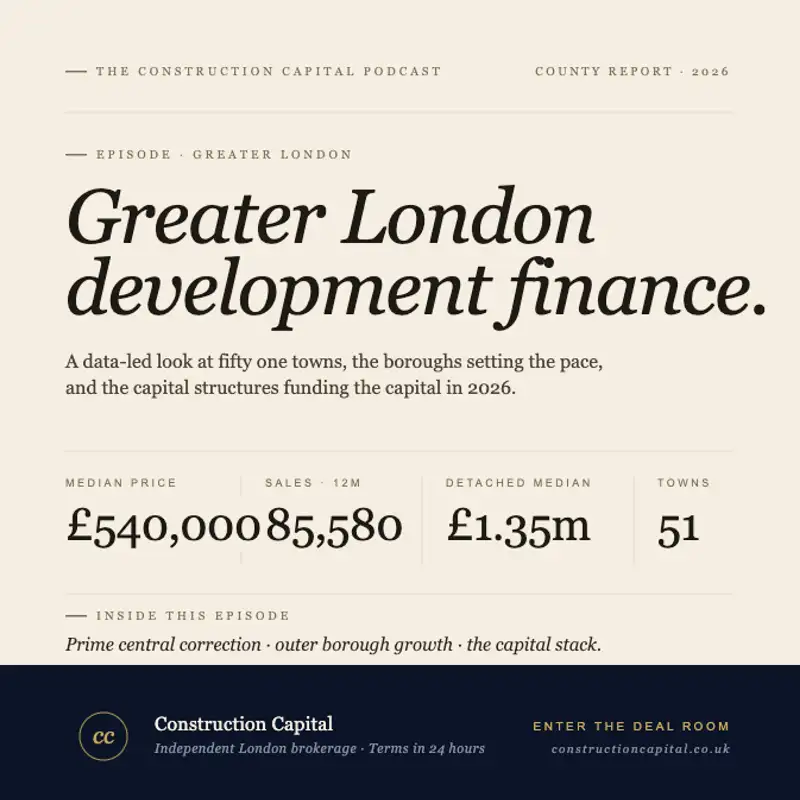
Greater London’s headline house-price index fell 3.3% year on year in February 2026 to a regional median of around £542,000 across roughly 85,580 transactions in the rolling twelve months. New-build completions ran at just 1.9% of total activity. Ealing’s +0.8% is 410 basis points above the regional benchmark.
The closest comparables are the sister Crossrail outperformers. Walthamstow at +5.9% — the eastern Victoria Line spillover with a tighter town-centre regen footprint than Ealing carries. Redbridge at +5.3% — the eastern Elizabeth Line corridor running through Ilford. Ealing at +0.8% is shallower than both because the borough’s premium stock at Ealing Common and the inner-Acton high-rise re-sale layer pull the headline back toward zero. That is not a structural weakness. It is a stock-mix effect on the headline number.
The cross-cluster reads matter. Hammersmith and Fulham at -7.8% is the immediate eastern neighbour — the prime west-London correction zone H&F sits in does not extend across the Acton Mainline boundary. Brent at -2.0% is the immediate northern neighbour — the three-masterplan NW London borough Ealing shares the Old Oak Park Royal opportunity area with. The Ealing-H&F spread is 860 basis points. The Ealing-Brent spread is 280 basis points. Both of those gaps are mostly the Crossrail catchment effect plus the Berkeley Southall Gasworks pipeline absorbing institutional capital that the adjacent boroughs cannot match on a single-site basis.
The Six-Station Borough: how Crossrail repriced western Ealing
The Elizabeth Line opened in 2022. The rerating of Ealing values across the Crossrail catchment has been working through every quarter since. The full financeability story — where senior lenders are pricing Crossrail-adjacent Ealing sites at the same terms as established outer-zone benchmarks, with BTR and PBSA institutional take-outs underwriting forward funds at sister-Wandsworth yields — is fully arrived in 2026.
Six Elizabeth Line stations inside the borough boundary. Acton Mainline (W3) on the eastern boundary, the Old Oak Common HS2 super-hub on the doorstep. Ealing Broadway (W5), the Crossrail terminus on the western branch and the borough’s town-centre commercial anchor. West Ealing (W13), the mid-tier resi-led growth station running through the Crossrail-fringe Edwardian terrace stock. Hanwell (W7), the family-resi mid-rise growth corridor with the Wharncliffe Viaduct as the visual anchor. Southall (UB1), the Berkeley Southall Gasworks station and the borough’s largest regen catchment. Plus Old Oak Common (W3) on the borough’s eastern fringe — the planned 2031 HS2 super-hub that adds a long-term call-option layer to North Acton residual land values.
That is more Crossrail catchment than any other London borough. Walthamstow has zero Elizabeth Line stations (it runs on the Victoria Line). Redbridge has five Elizabeth Line stations. Newham has two. Tower Hamlets has one (plus three at the Canary Wharf fringe). Hounslow has zero direct (West Drayton sits on the western branch outside the borough). The six-station Ealing footprint is structurally unique on the western branch.
Sites within a 10-minute walk of any of the six stations are clearing £600 to £750 per square foot on consented mid-rise resi schemes — comfortably above the £650 per square foot viability threshold. Sites within a 5-minute walk are clearing £700 to £900 per square foot, which puts North Acton high-rise BTR and PBSA new-build into the bracket where institutional forward funding underwrites the senior layer at outer-band pricing.
The sub-zone anatomy: Ealing Broadway, Acton Mainline / North Acton, West Ealing, Hanwell, Southall, South Acton, Greenford / Northolt / Perivale, Park Royal corridor
Ealing Broadway and Ealing Town (W5). The borough’s commercial and resi-led town-centre anchor. Ealing Broadway Crossrail terminus on the western branch, plus Central Line, District Line. Ealing Town Hall, Christ the Saviour, Walpole Park, Pitzhanger Manor. Ongoing town centre regen with new mid-rise resi consents around the Broadway gyratory and the Uxbridge Road frontage. £600-700 per square foot on credible mid-rise resi-led schemes. Senior debt at 70% LTGDV at 6.25%.
Ealing Common, South Ealing, Northfields (W5). The borough’s premium domestic anchor. Edwardian and Edwardian-Tudor stock across Ealing Common itself, the South Ealing / Northfields corridor, Pitshanger Lane. £700-900 per square foot. Held value through the 2025-2026 prime correction because the catchment is structurally west-London family-resi rather than international-prime. Bridging-led value-add reposition at 0.55-0.70% per month is the dominant capital flow. Selective conversion / repositioning finance at 65% LTGDV at 7.0%.
West Ealing (W13). The mid-tier resi-led growth station. Crossrail at West Ealing has been the structural catalyst since 2022 — the catchment runs through the Drayton Green / Northfields fringe to the south and the Crossrail-side Drayton Green Road / Singapore Road frontage to the north. £600-700 per square foot on credible mid-rise resi-led schemes. Senior at 70% LTGDV at 6.25-6.5%.
Hanwell (W7). The family-resi mid-rise growth corridor. Crossrail at Hanwell. The Wharncliffe Viaduct (the Brunel-era arched viaduct visible from the station) is the visual anchor. Mid-rise consents along the Uxbridge Road, Boston Road and Greenford Avenue corridors. Family-resi catchment with strong school-zone overlay. £550-650 per square foot. Senior at 70% LTGDV at 6.25%.
Southall (UB1, UB2). The borough’s largest single regen catchment. Crossrail at Southall, plus the Berkeley Southall Gasworks masterplan (~3,750 homes consented across the wider footprint, sequenced through 2026 to the early 2030s). Town centre regen running concurrently. The Southall Crossrail catchment runs through the Western Road / Norwood Road / South Road / Southall High Street frontages. £550-650 per square foot on credible mid-rise resi-led schemes outside the masterplan. Senior at 70% LTGDV at 6.25-6.5%. Berkeley masterplan phases on cross-borough institutional underwrite at 65-70% LTGDV at 6.5-6.75%.
Acton (W3) — Acton Mainline / North Acton / East Acton / West Acton / South Acton / Acton Town. Six Acton stations across five lines (Crossrail, Central, District, Piccadilly, Overground at Acton Central). North Acton W3 is the high-rise PBSA and BTR cluster — Imperial College West London catchment, Acton Mainline Crossrail, multiple high-rise PBSA and BTR consents across the Wales Farm Road / Portal Way / Bromyard Avenue / Ostara Road footprint. £750-900 per square foot on new-build high-rise. South Acton (W3) is the LB Ealing estate regen long-term phase. East Acton W3 is family resi mid-tier. West Acton W3 is family resi premium-fringe. Acton Town W3 sits on the Piccadilly / District interchange and runs as a connected outer mid-tier resi-led catchment.
Greenford, Northolt, Perivale (UB5, UB6). The outer-fringe Central Line and Piccadilly Line catchment. Family-resi mid-rise the dominant typology. The conventional borough comparable read applies. £450-550 per square foot. Senior debt at 70% LTGDV at 6.25-6.5% on credible mid-rise resi-led schemes. Conventional capital structure.
Park Royal corridor (NW10, W3) — Old Oak Park Royal opportunity area fringe. Light-industrial and B-class footprint. The Ealing slice of the wider OOPR opportunity area sits along the eastern boundary with Brent and the northern boundary with H&F. Long-end optionality on the OOPR delivery curve, currently early-stage from a deal-flow perspective on the Ealing side. The HS2 super-hub at Old Oak Common (planned 2031) adds a structural call-option layer to the North Acton fringe of the corridor. Industrial intensification + co-location resi schemes are the active product.
Why North Acton is the borough’s high-rise PBSA + BTR cluster
North Acton W3 is the borough’s structural growth zone for institutional capital. The combination of Acton Mainline Crossrail (8-10 minutes to Paddington, 14 minutes to Bond Street, 20 minutes to Tottenham Court Road), the Central Line at North Acton (the second seat into Bond Street and the City), the Imperial College West London campus catchment (Imperial’s expansion footprint that complements the White City campus to the south), and the Old Oak Common HS2 super-hub on the doorstep (planned 2031, with HS1-via-HS2 connectivity adding meaningful long-end optionality) is what makes North Acton the densest concentration of high-rise consents in west London outside of White City.
The active high-rise pipeline at North Acton includes multiple delivered and consented PBSA towers, plus BTR towers across the Wales Farm Road / Portal Way / Ostara Road footprint. Active operators include the major UK PBSA institutional funds and the institutional BTR pool that has been deploying into Wandsworth Battersea / Nine Elms and Brent Wembley Park concurrently. Net yields on credible North Acton PBSA forward funds clear 5.0 to 5.25% — the tightest PBSA cluster yields in west London outside of White City Imperial. Net yields on credible North Acton BTR forward funds clear 5.0 to 5.5% — broadly in line with Brent Wembley Park (Quintain Tipi anchored), Wandsworth Battersea / Nine Elms, and Hackney Wick.
The Imperial College West London anchor matters specifically. Imperial has been progressively building a West London footprint that complements the White City campus to the south. The combined Imperial White City + Imperial West London catchment is the institutional life-sciences and STEM postgraduate cluster in inner-west London. PBSA forward funding into the wider catchment underwrites the institutional take-out on the construction layer at sharper yields than open-market BTR — and that is the structural reason North Acton has continued to attract capital through the 2026 correction window.
The Southall Gasworks Berkeley masterplan
Berkeley Group’s Southall Gasworks masterplan is the largest single regen pipeline in the borough by GDV. Approximately 3,750 homes consented across the wider footprint through the National Grid Southall Gasworks redevelopment — the Western Road / South Road / Brent Road site that has been progressively brought into delivery since the early 2020s. Delivery sequenced through 2026 to the early 2030s.
The institutional take-out on the higher-density phases is structured around BTR forward funding, with senior construction debt sized against the phase-level capital stack rather than the masterplan-level GDV. Senior debt at 65 to 70% LTGDV at 6.5 to 6.75% per annum on credible Southall Gasworks phase work is what makes the masterplan financeable through the correction window. Selected phases have BTR forward-fund commitments locking the take-out at 5.0 to 5.5% net.
The cross-stack institutional underwrite is the structural feature. The lender pool prices the Southall Gasworks phases on the masterplan absorption profile and Berkeley’s covenant strength rather than on the borough’s headline number. That means the +0.8% borough headline feeds into the underwriting only as a comparable input, not as the phase-level appraisal anchor. The net yield achievable on the BTR take-out — sharper than the open-market resi mark — is what compresses senior pricing on the construction layer by 25 to 50 basis points relative to an open-market resi structure of the same scale.
What lenders are pricing on Ealing schemes in 2026
Following the Bank of England’s December 2025 cut to 3.75%, the all-in capital stack on a typical Ealing scheme is one of the most lender-friendly outer-band structures in west London. The borough is materially closer to Walthamstow and Redbridge pricing than to the inner-band correction zone. The Crossrail catchment plus the structural pipeline depth (Southall Gasworks, North Acton high-rise PBSA / BTR, Ealing Town Centre absorption) all clear viability comfortably.
Senior development finance on an Ealing, Acton, Hanwell, West Ealing, Greenford, Northolt or Perivale resi-led mid-rise scheme is pricing 6.25% per annum at 70% LTGDV. Outer-band pricing on transport-adjacent stock. Five percentage points wider on leverage and 25 basis points wider on margin than connected outer Walthamstow / Redbridge — the spread is the borough’s slightly more diversified stock mix.
Senior debt on a North Acton high-rise BTR or PBSA scheme prices at 65 to 70% LTGDV at 6.5% per annum. Slightly tighter on the high-rise tier but well inside the H&F White City equivalent pricing because the institutional take-out structure de-risks the back end. Senior debt on Southall Gasworks Berkeley masterplan phase work prices at 65 to 70% LTGDV at 6.5 to 6.75% per annum, depending on the BTR vs open-market resi mix in the phase and the institutional take-out structure.
Mezzanine finance prices at 12% per annum, layered to 85 to 90% of cost. The mezz pool is competitive on Ealing because the underlying senior structure is tight. JV equity providers are demanding 18 to 22% IRR targets on Ealing resi-led — broadly in line with Walthamstow / Redbridge / Wandsworth and tighter than the inner-band correction-zone boroughs.
Bridging loans are very active on the Ealing Common / South Ealing / Northfields premium townhouse value-add corner. Edwardian and Edwardian-Tudor stock at £1.5m to £4m, refurb-to-rent or refurb-to-sell, 9 to 14 month construction window. Bridging at 0.55 to 0.70% per month at up to 75% LTV is the standard structure.
The structurally active institutional product is twofold. PBSA forward funding at North Acton on the Imperial College West London catchment at 5.0 to 5.25% net yield. And BTR forward funding at North Acton + Southall Gasworks at 5.0 to 5.5% net yield — broadly in line with Brent Wembley Park, Wandsworth Battersea / Nine Elms and Hackney Wick. Together these absorb a meaningful share of the borough’s 2026 senior debt capacity at near-Wandsworth pricing.
What is actually transacting in Ealing
Six categories of scheme are running across the borough in 2026.
North Acton high-rise BTR + PBSA forward funds. The dominant institutional product by GDV. Imperial College West London catchment + Acton Mainline Crossrail + Central Line + Old Oak Common HS2 super-hub on the doorstep. Net yields 5.0 to 5.5% BTR, 5.0 to 5.25% PBSA. Senior construction debt on a forward-funded scheme prices at 6.5% per annum at 65 to 70% LTGDV.
Southall Gasworks Berkeley masterplan phase work. The largest single regen pipeline in the borough. Cross-stack institutional underwrite. Senior at 6.5 to 6.75% at 65 to 70% LTGDV. Selected phases with BTR forward-fund commitments at 5.0 to 5.5% net.
Ealing Town Centre mixed-use. Mid-rise resi-led around the Broadway gyratory and the Uxbridge Road frontage. Diversified resi-led stock. Senior at 70% LTGDV at 6.25%.
Acton Mainline / West Ealing Crossrail-fringe mid-rise. Mid-rise consents within a 5-10 minute walk of either Crossrail station. £600-750 per square foot. Senior at 70% LTGDV at 6.25-6.5%.
Hanwell family-resi mid-rise. Mid-rise consents along the Uxbridge Road, Boston Road and Greenford Avenue corridors. Crossrail catchment with school-zone overlay. Senior at 70% LTGDV at 6.25%.
Ealing Common / South Ealing / Northfields townhouse value-add reposition. Bridging-financed at 0.55-0.70% per month. Edwardian and Edwardian-Tudor stock between £1.5m and £4m. Refurb-to-rent or refurb-to-sell windows at 9 to 14 months. The borough’s most consistent bridging deal-flow corner.
What is much smaller in 2026: ground-up new-build resi-led origination on the very small number of consented sites in the prime W5 / W13 fringe of the Ealing Common premium catchment. The capital stack on those sites requires meaningful equity (30%-plus of cost) and a strong sponsor track record specifically in the west-London family-resi market.
How the capital stack works on a £30-50m GDV Ealing scheme
A typical mid-cap Ealing resi-led scheme at this scale, with strong PTAL within a 10-minute walk of an Elizabeth Line or Central Line station, a credible mid-rise consent (4 to 14 storeys, 60 to 250 homes), a clean planning consent under the new NPPF regime, can be financed with senior development finance at 70% LTGDV (around 6.25% per annum), mezzanine layered to 85 to 90% of cost (around 12% per annum), and either an open-market resi take-out or a BTR forward-fund commitment locking the back end.
Blended cost-of-funds on an open-market resi-led Ealing structure of this scale sits in the high sixes to low sevens. With a BTR forward-fund commitment at 5.0 to 5.5% net the senior layer compresses by 25 to 50 basis points and the blended drops further into the mid-to-high sixes. That is sharper than Hammersmith and Fulham equivalent pricing inside the prime correction zone, sharper than Brent Wembley Park (slightly), and broadly in line with Wandsworth Tooting and Walthamstow / Redbridge.
On a North Acton high-rise BTR or PBSA scheme of the same scale, the structure shifts to senior at 65 to 70% LTGDV at 6.5% per annum, mezzanine to 85 to 90% of cost at 12% plus, and an institutional forward-fund take-out at 5.0 to 5.5% net BTR or 5.0 to 5.25% net PBSA. Blended cost-of-funds in the high sixes to low sevens. Tighter on the back end than an open-market resi structure because the institutional take-out de-risks the absorption window.
On a Southall Gasworks Berkeley masterplan phase scheme, the structure is similar but priced 25 to 50 basis points wider on the senior layer to reflect the masterplan-level institutional underwrite — senior at 65 to 70% LTGDV at 6.5 to 6.75% per annum, mezzanine to 85 to 90% of cost at 12% plus, BTR forward-fund take-out at 5.0 to 5.5% net on selected phases. Blended cost-of-funds in the low sevens. The masterplan-level absorption profile carries the capital stack across multiple delivery cycles.
What this means for site acquisition
If you are pricing land in Ealing in 2026, three things matter more than they have in any recent cycle.
One, the Crossrail catchment is the appraisal driver, not the borough number. The +0.8% borough headline understates the structural pricing tightness inside a 10-minute walk of any of the six Elizabeth Line stations. A Crossrail-adjacent Acton Mainline, Ealing Broadway, West Ealing, Hanwell or Southall plot runs on outer-band lender pricing at 70% LTGDV at 6.25% per annum, with BTR forward funding available on credible mid-rise schemes at 5.0 to 5.5% net. A North Acton high-rise plot runs on institutional PBSA / BTR forward fund at the tightest yields outside of White City Imperial. A Southall Gasworks plot runs on Berkeley masterplan-level institutional underwrite at cross-stack pricing. Same borough, multiple valuation models, materially different residual land values. Underwriting all of them is the discipline.
Two, the institutional product (North Acton PBSA at 5.0-5.25% net yield, North Acton + Southall Gasworks BTR at 5.0-5.5%) is in the institutional sweet spot for west London and is the structural product the borough is optimised for through 2025 to 2030. If you have a North Acton plot that supports the PBSA or BTR yield calculation with credible operator commitment, or a Southall Gasworks phase that supports the BTR forward-fund yield calculation with rental tone and operational delivery economics, that is a financeable product on better terms than an open-market resi structure on the same plot.
Three, the post-NPPF planning regime, the Mayor’s emergency package and the Time-Limited Planning Route at 20% affordable housing by habitable room together favour Ealing schemes that move quickly through to delivery. The borough has consistently been one of the more pragmatic west-London planning authorities through the post-2024 reform window — that is the structural reason the consenting pipeline at North Acton, Southall and across the wider Crossrail catchment has continued to absorb through the 2026 origination thinning seen in adjacent inner-west boroughs.
For full borough-by-borough sold price data, the Southall Gasworks Berkeley masterplan phasing detail, the North Acton high-rise PBSA / BTR pipeline references and the underlying capital stack benchmarks behind this analysis, see the Greater London Property Market Report 2026. Borough-specific intelligence sits on the Ealing location page.
See also: Walthamstow +5.9% on YouTube and The £650/sq ft Cliff on YouTube.
Listen to the full episode
For the dedicated deep dive on this borough, we have published a stand-alone Ealing episode of the Construction Capital podcast: Ealing +0.8%: The Crossrail Outperformer — North Acton, Southall Gasworks and the Six-Station Borough. Around fifteen minutes covering the four-sub-zone read, the six Elizabeth Line stations and the Old Oak Common HS2 super-hub on the fringe, the Berkeley Southall Gasworks 3,750-home masterplan, the North Acton high-rise PBSA + BTR cluster anchored by Imperial College West London, the full April 2026 capital stack, and what is actually transacting in 2026.
This article also draws on Episode 2 of the Construction Capital podcast: Greater London Property Development Finance 2026: Market Analysis, House Prices and Lending Outlook. The full borough-level data, policy detail and capital stack discussion runs 15:30, with chapters covering Walthamstow, Redbridge, Bromley, and the wider Greater London outlook.
Listen anywhere
Listen on Apple Podcasts, Spotify, Overcast, Pocket Casts, or Amazon Music.
For indicative terms on an Ealing scheme within 24 hours, submit through the Construction Capital deal room. Construction Capital sources terms from over 100 lenders across development finance, bridging, mezzanine and equity.
Published by Construction Capital, an independent capital advisory brokerage sourcing terms from over 100 lenders across development finance, bridging, mezzanine, and equity. This article is part of the Greater London 2026 series accompanying the Construction Capital podcast.